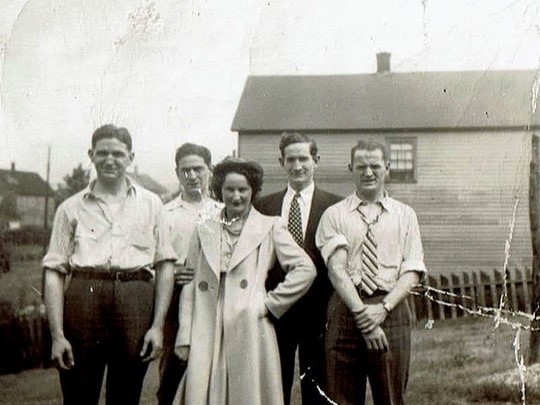
My family life was lived in the presence of an extended family. After my mother died, my father, who had been living and working in Allentown, moved back to Scranton to reside in a large rental house with members of my mother’s family. I think the decision was made that he couldn’t or shouldn’t raise my sister and me on his own without maternal influence. This was in 1944 and a single parent household was likely rare. Thus it came about that I was raised in a house occupied initially by 10 people – Grandpa and Grandma Gallagher, Aunt Ann, Uncle Mike, and Uncle Joe (who were my mother’s parents, sister and brothers), Uncle Bill (who was married to Aunt Ann and who was also my father’s brother), my cousin Jackie (the child of Aunt Ann and Uncle Bill), my Dad, my sister Joan, and myself. My grandfather died about a month after we all moved in together. I’ve been told that he was sick for some time but was determined to live long enough to see Sally’s baby boy. It had to be really hard on my grandmother to lose her husband and her daughter within 3 months of each other, and painful as well for my mother’s siblings to lose their father and sister in that short timeframe. I would presume that the joinder of the three family units in one household took place amidst much grief for some period.
The address of our house was 1504 Jackson Street in West Scranton. A description of the house and its rooms and amenities, or the lack thereof, is relevant to an understanding of much of my early family life because aside from school and church that house was the locale for how my days were spent both on my own and with my extended family. The house was what was then called a “half double”, meaning two residences separated by common walls. Perhaps today it would be called a duplex. The rent was $60 a month and to the best of my knowledge it was never raised by the owner of the property (Mrs. Lunney) who lived on the other half of the housing structure with her daughter and son-in-law and two grandchildren. Her grandson, Bobby Jones, was my age and we were playmates. Bobby contracted a serious illness (to this day I don’t know what it was) and died when he was 7 years old. Bobby’s parents and sister then moved to New Jersey and another daughter of Mrs. Lunney moved into her side of the property along with her husband and son. Mrs. Lunney was a stern and often unpleasant woman and she didn’t get along well with that daughter and son-in-law. We would frequently hear them arguing and screaming at each other. Aunt Ann was scared to death of her, constantly concerned that no one on our side of the property say anything that would anger Mrs. Lunney or her daughter because they might hear it through the thin walls that separated the two sides. So one part of my early family life was seeing the death of my first childhood friend and fearing hostility from our landlord neighbors.
The downstairs of the house consisted of three rooms, the kitchen, and a pantry. The front room was mostly used only to greet any visitors, except at Christmas time when our tree and gifts were displayed there. In the winter, other than the attic, the front room was the coldest room in the house so it was not conducive to sitting in there. The next room was our living room which had a piano that was rarely played and an old-time standing radio (until television sets came out). We huddled around that radio almost every evening after supper, especially during the winter months, to listen to our favorite shows. It was replaced eventually by our first television set. Grandma and Aunt Ann watched certain programs and soap operas during the morning and early afternoon hours, and most days I would watch television in the late afternoon when I got home from school. Everyone but Grandma and Aunt Ann would watch TV in the evening and weekends. Much of my early childhood activity was just being passively entertained by radio and TV shows.
The living room led into the dining room which had a large dining table, a china closet, and a credenza. We only used the dining room for meals on holidays or when we had company dining with us. I spent a lot of time in the dining room, however, because we did not have any separate play area. The dining room table became my play space. It’s where I played for hours with my beloved Cowboy and Indian set. It’s where I colored in my coloring books and painted in my paint-by-number sets. It’s where I cemented model airplanes. It’s where I put my puzzles together. It’s where Jackie and I played with our electric football game, our all-star baseball game, and our pop-up basketball game. It’s where I played children’s card games with Jackie, canasta with Joan and Jackie, and as I got older, pinochle with Dad and Uncle Bill. It’s where I played various board games with the family. It’s also where I did my homework. The dining room truly was my playroom. Jackie and I even played an indoor basketball game in that room which involved tossing a rolled-up sock from one end of the room to a vase with a wide opening on the other end of the room.
We had a tablespace kitchen, but only six could fit at the table. Breakfast was never a problem because we got up at different hours. Supper dining was usually in shifts. Grandma and Uncle Joe ate before 5 because Grandma would go upstairs for the night at 7 and Joe had a 6 a.m. to 3 p.m. workday so he was hungry early. Dad, Joan, Jackie, Uncle Bill and me would eat whenever Dad got home from work, which normally was around 6. Aunt Ann cooked and served the meal to us and she wouldn’t sit down to eat until we were all finished. We didn’t have a dishwasher so after supper the dishes, glasses and utensils were cleaned at the sink by hand. Uncle Bill and Joan usually did the washing and Dad and I handled the drying. Adjacent to the kitchen was a pantry room. We didn’t have kitchen cabinets, but the pantry was large enough to store all nonrefrigerated food products and supplies. On the top shelf of the pantry, out of the reach of us kids, there always was a bottle of whiskey. No one drank straight whiskey in our house, but a bottle was kept there so you could swish it around your mouth if you had a toothache.
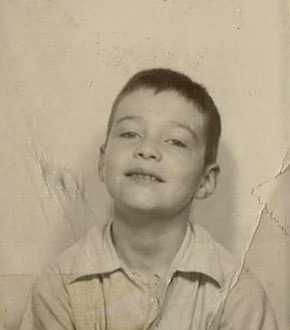
There were 18 steps to climb to reach the upstairs in our house. On that level there were 1 large bedroom, 2 medium bedrooms, one small bedroom, and one bathroom. Think about that – one bathroom for 8 or 9 people. And where did everyone sleep? The upstairs was clearly the most dysfunctional of all aspects of our extended family life. Uncle Mike had the small bedroom until he got married in 1950. Joan was then given that solo room which, although small, was the most desirable bedroom because it was right next to both the bathroom and a separate staircase that led directly to the kitchen. Prior to that move Joan slept either in the large bedroom with Grandma and Uncle Joe or in the medium bedroom with Dad and me. The large bedroom was at the front of the house and thus had the best view (the only view actually, because all of the other bedrooms looked out upon the siding of the house next door). It was spacious enough to be not only a bedroom for Grandma and Uncle Joe but also to accommodate dressers and chests of drawers for storage of clothing, towels and linens for the entire household. Three people died in that front bedroom – Grandpa, Grandma, and Uncle Joe (who died as we all wish, in his sleep). One of the medium bedrooms was occupied by Uncle Bill, Aunt Ann and Jackie, and the other by Dad and me (and Joan part of the time). For the 22 years I lived at 1504 Jackson St. I shared a bedroom with my Dad. How’s that for father-son bonding? As for the bathroom, it had a toilet, a sink, a tub, and a mirror, and that was it. No space to store or place toiletries and no shower.
The house had an attic and a cellar. The attic was used only for storage of mostly old stuff that should have been thrown away. It was never heated and if you went up there in the winter you would have to wear your winter outer clothing. I discovered by accident one Christmas season that there were unopened toys and games up there, so when I saw them again on Christmas Day as gifts from Santa I had an epiphany. A sad note about the attic is the fate of my extensive and potentially valuable baseball card collection. I put the collection in the attic when I left Scranton for law school. No one bothered a few years later to clean out the attic when the house was being razed by the new owner, so my priceless card collection presumably wound up as part of the demolition debris. The cellar was always damp and the only reason to ever go down there was to gather coal from the coal bin and stoke it in the coal furnace. For some reason that became Uncle Joe’s main chore. I started to help him when I got a little bit older. Then every Wednesday night during the colder months Uncle Joe, or he and me, would haul large buckets of ashes from the cellar to the alley at the end of our back yard because the ash truck came by on Thursday morning. I don’t ever remember Dad, Uncle Bill or Jackie stoking the coal furnace or carrying the ashes. I wonder what the trade-off there was.
We had a decent size back yard which we shared with our landlord’s family. It was large enough to play wiffle ball with neighborhood kids and run around make-shift bases. It was mostly a dirt yard with grass to be cut only at the north end. I remember riding my 3-wheel bike around that yard on many a day. There was a flat paved area in the alley next to our yard and that’s where we would flip baseball cards and play marbles. Another outside activity at our house was playing “balls and strikes” on a 6-foot wide walkway between our house and the house to our right. Jackie and I, and less frequently another kid and I, would take turns being the pitcher and catcher, to see who could record the most strikeouts. The catcher was also the umpire, but I think we played that game honestly and always called them as we saw them.
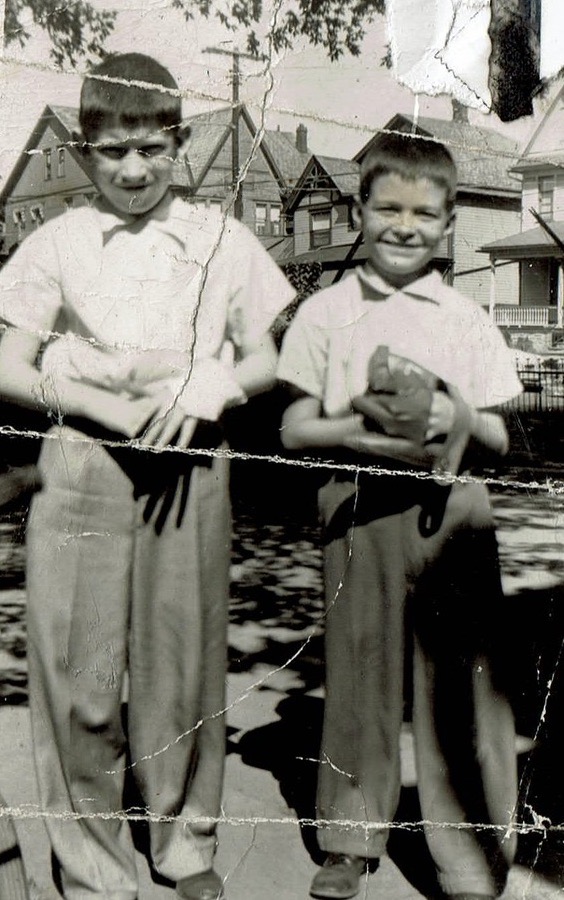
The house had a great front porch which extended over both sides of the property and a separate small back porch. We had comfortable porch furniture, including a glider that I always tried to claim (unsuccessfully) as mine alone to stretch out and enjoy. The porch furniture had to be moved to the cellar when winter arrived and then put back out on the porch in the spring. A problem there was that Aunt Ann would not allow us to put out our chairs and glider until our landlord’s family put out their porch furniture, and they were often late in doing so. I think she was afraid that if we furnished our side first that would be negatively perceived by the landlord as an act of one-upmanship. The front porch was used just about every night in the warmer months by Dad, Uncle Bill, Jackie and me. We listened to countless radio broadcasts of baseball games on that porch. Since our house was located within a stone’s throw of a neighborhood grocery store, a barber shop, a tailor, a school and a church, folks were always passing by, and if we were out on the porch they would frequently stop to chat or just say Hi. Scranton does, of course, call itself the Friendly City. During the summer I would spend daytime on the front porch swinging on the glider and reading my comic and library books, or playing a silly game with Jackie which involved selecting a color and then watching the cars go by to see which of us selected the color of the most cars. The back porch had only two chairs and while I occasionally sat out there talking to Grandma, it was she and Uncle Joe who usually sat on that porch. Since we did not have a washer/dryer and all our clothes were run through a three-ring washer in our kitchen (which gave off an unpleasant scent for the rest of the laundry day) the other use of the back porch was that it served as the starting and ending point for the outdoor clothesline on which washed clothes were hung to dry.
So why have I shared this mundane and detailed description of my childhood home? It’s because I think one can glean from it at least a glimpse of what my early family life was like. While it clearly was not a typical family household environment I have fond memories of that house and those rooms and the love that I always felt there. My childhood home will always be part of me. After all, you know what they say – you can take a kid out of Vegas, but you can’t take Vegas out of the kid (or something like that).
 'Tis The Drink Talking