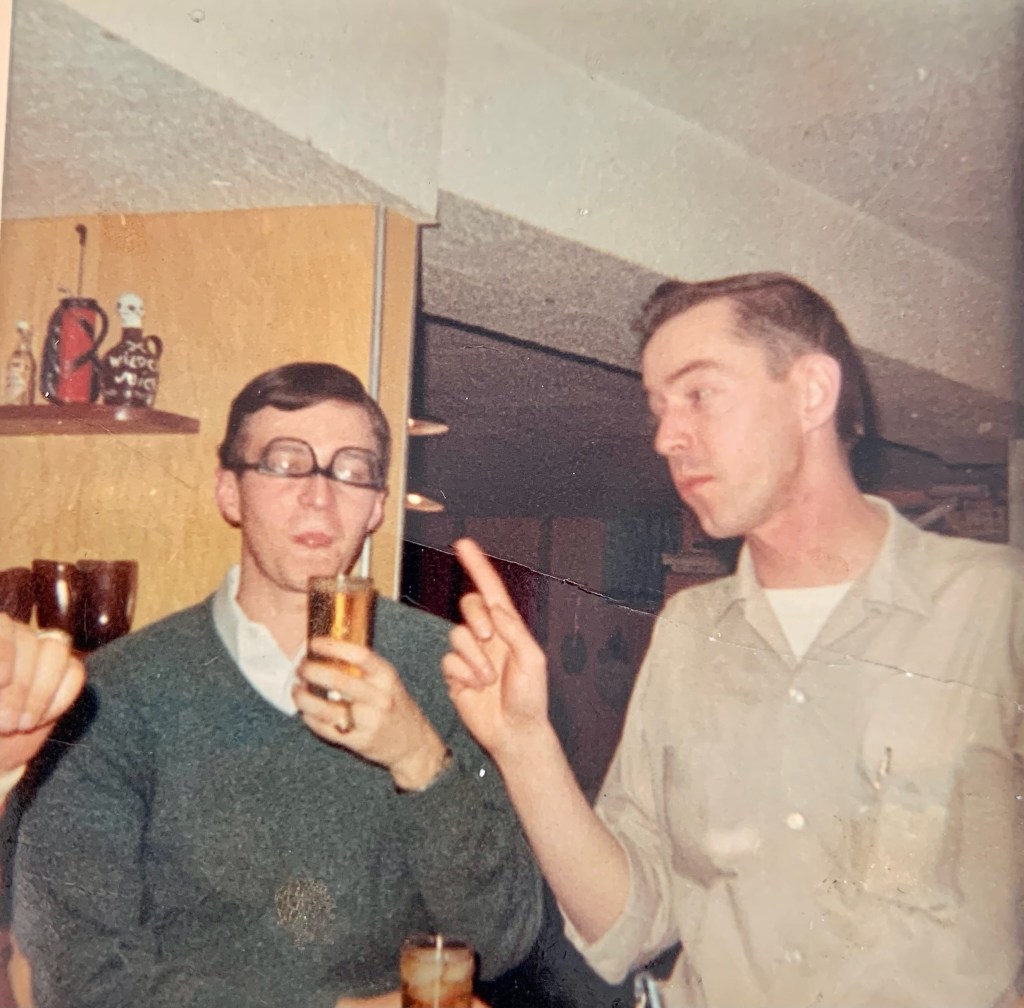
I did enjoy law school more than college because that’s when I started smoking. I thought it was a cool thing to do and for some inexplicable reason it seemed to provide me with a sense of self-confidence, or at a minimum it allowed me to feel more at ease in new and sometimes stressful circumstances.
As to how well I balanced my social life with law school studies, that was an evolutional process which culminated in my last year of law school. In expounding on that I need to start at the beginning, and that was when I decided to be a draft dodger, just like two of my idols, Bill Clinton and Donald Trump (but not a philanderer). The war was raging in Vietnam in 1966 and I was at a peak draft age. However, a deferment could be granted to an undergraduate who was going on to graduate school. When I think about that today it strikes me how unfair and discriminatory that policy was, since it exempted young men who had the wherewithal to continue their education. Nevertheless, I applied for the graduate student deferment (a 2-S draft board classification) and in order to do so I had to demonstrate that I was going to pursue graduate studies. Two of my friends from college were signing on to take the Law School Admission Test (LSAT) and at the last moment (literally on only 48 hours notice) they persuaded me to take the test as well, so I would be able to satisfy the local draft board as to my graduate school intention. What actually occurred, however, was that before the 2-S status was granted I was required to undergo the draft physical, after which I was classified as 1-Y, meaning I would only be drafted in the event of a national emergency. The reason I was given for failing the physical was my hearing loss, a concern that I wouldn’t be able to hear approaching gunfire or bombs in the southeast Asia jungle.
So the reason I took the LSAT was to stay out of the war, and the reason I ended up in law school is that I had the good fortune to do well on the LSAT. I applied to four law schools, two in my home state of Pennsylvania (Villanova and Temple) and two in Washington, D.C. (Georgetown and Catholic University). The standards must have been low that year because I received a scholarship offer from each of the four schools. Being shamelessly idealistic I resolved that if I was going to be a lawyer I want to be where our most important laws are made and that has to be our Nation’s Capital, thus eliminating the two Pennsylvania contenders. My Dad and I traveled to D.C. to visit the Georgetown University and Catholic University of America (CUA) schools and campuses. Georgetown had the more renowned reputation and was located in a dynamic section of the city. CUA had a number of professors who were full-time practicing lawyers and in my view had a nicer integrated campus environment. I wound up choosing CUA because it gave me more of a free ride, i.e., not only a full scholarship but also room and board. Georgetown offered the tuition scholarship but did not have graduate housing so it couldn’t include room and board in its grant. It would have been an honor to have my law degree from Georgetown, a law school with many prominent alumni (and which would have been my second Jesuit degree), but I have never regretted my decision to go to CUA.
Without a doubt the first year of law school is the hardest. The required courses were fairly standard in most law schools, such as Constitutional Law, Contracts, Torts, Civil and Criminal Procedure, Property Law, and most importantly Legal Writing and Research. My favorite was Constitutional Law because the opinions we read were so scholarly analyzed and written by Supreme Court Justices. We studied day and night during that first year, in classes and in the law library, and on weekends as well. There were no tests or quizzes during the year, only a final exam at completion of the course, so we never really knew how we were doing, and I would venture to say that most of us felt for sure that we were going to fail. The Dean of the law school was an elderly man who was at CUA for about three decades. He was a bit of an eccentric self-indulgent person not easily given to praise. So I was absolutely thrilled when in the summer of 1967, after my first year of law school, he called me at my Scranton home to congratulate me on having the third best grade in the class and informing me that I qualified to join the Law Review staff when I return in September for my second year.
Since the first year was focused so much on studies there wasn’t much opportunity for a social life. I bunked with three other law students in a 4-person suite with a common bath and sitting area in an off-campus residence hall.. They were all from New England so they had that in common. For the most part my social activity was centered around occasionally hanging out with them. On many a Saturday night we did frequent a German Rathskeller in downtown D.C. where we would imbibe pitchers of Lowenbrau and participate in the establishment’s sing-along. I do remember that on one night upon our return to the dorm we carried the sing-along too far when the four of us crawled under my bed, which was covered with a yellow blanket, and sang the Beatles’ Yellow Submarine song. That was about as much fun as there was in year 1 of law school. I also recall attending my first and only house party during the second semester of that first year. I cannot remember who dragged me there, but there were dozens of students, mostly undergraduates, drinking and smoking and dancing and kissing in this one off-campus house. It would remind you of a party at an Animal House frat. It was so noisy and congested that I couldn’t wait to get out of there, thinking the police will arrive any minute. That social life was not for this nerd.
I resided in a dorm on the main campus during my second and third years at CUA and had a spacious single room with private bath. My lodging was just a stone’s throw away from the National Shrine of the Immaculate Conception where I would sometimes attend Mass in the crypt church and more often enjoy a late breakfast in the church’s cafeteria. I invested in my first television set and my room began to host a number of other students for basketball and other televised sporting events. There was enough space in the room for a keg which encouraged new friendships.
I enjoyed most of the courses I took during my second and third years, such as Estates and Trusts, Taxation, Administrative Law, Corporations, Criminal Law, and Family Law (but not Securities Law – ugh!). They were electives and seemed to require less study time than the first year basic courses. That meant in turn that there could be more opportunity for a social life. I developed new friendships and we frequently would go to bars in Georgetown and attend get-togethers or mixers at two female colleges, Dunbarton in Georgetown and Trinity near CUA. The venue of choice most nights, however, was a divey saloon called Dick & Gary’s located just across the Maryland line in Hyattsville. This was the place that my closest law school friends and me would often close down at 2 a.m. It had two pool tables and a dart board in a back room and served as good a cheeseburger as you would find anywhere.
Highlights of my second year were my participations in the Moot Court competition (getting to the semi-finals) and in the judicial arraignment process for the rioters/looters following the assassination of Martin Luther King, both of which I will discuss in a subsequent chapter. During my third year I chauffeured Senator Wayne Morris of Oregon one evening from the Senate Office Building to the CUA campus and back. Senator Morris had the reputation of being a maverick Senator and he was an unrelenting critic of the Vietnam war. The occasion for his visit to CUA was to deliver his anti-war message to the student body of the law school. One of my first year roommates was the President of the Student Bar Association and since he did not have a car he asked me to provide the transport for the Senator. We had pleasant conversations and I think he liked my Cougar convertible, although it was too cool an evening to put the top down.
During the summer between my second and third years I interned as a law clerk for a firm in Scranton. It was a multi-practice law firm but most of my time was spent working on a labor law case with the firm’s labor specialist. He was both very bright and instructive. I particularly liked being involved in one case where a negotiation between management (represented by my lawyer mentor) and labor quelled a union strike. At the time I thought that I might pursue a career in labor law, although I resolved that if I did so I would want to be on the side of labor rather than management.
A large part of my second and third years in law school involved the CUA Law Review. Most law schools publish a scholarly journal or publication, usually quarterly, which is called Law Review or Law Journal. It includes articles, comments and case notes relating to current or topical legal issues, and is produced by the top students in the second and third year classes. I worked on the staff of the Law Review during my second year and was selected as one of the six Editors for my third year. My title was Comment Editor. We spent a lot of time together and became friends. It was a rewarding experience. The major contribution I made was to engage with Sam Dash, a Georgetown law professor, in researching, writing and editing a Comment article on the legality of wiretapping and eavesdropping, a subject on which he was regarded as an expert. Professor Dash became even more well known five years later when he served as lead counsel for Senator Sam Ervin, the Chairman of the Committee investigating the Watergate scandal.
After finishing the Comment article Professor Dash asked me to be one of his research assistants on a new casebook he was writing on Criminal Law and Procedure. Since I had planned to stay in Washington anyway after graduation so I could prepare for the bar exam in August 1969 I accepted the offer. I spent my days during the spring and summer of 1969 doing research for him at the Institute for Criminal Law and Procedure down in Georgetown. In the evenings I would attend bar review sessions and/or study for the D.C. bar review with Margaret, a law school classmate who I started dating in my third year. Margaret lived in a townhouse with two other girls on Capitol Hill, so my social scene moved from Georgetown and Hyattsville to the more sophisticated Capitol Hill establishments. I passed the bar exam but Margaret unfortunately did not. Not long after the results came out she dumped me. Maybe she thought I was a jinx.
I know I’ve given more than you bargained for in this essay, but I feel that my law school experience was for me much more than a legal education. I have to say that with the exception of the years 1971-2004 my three law school years were the happiest years of my life.
 'Tis The Drink Talking